

Every morning at 7:40, Türkenschanzpark fills with the same sound: kids shouting "I don't want to go to school" in three languages. Twenty minutes later the park empties, and an hour after that it refills — this time with strollers, grandmothers and dogs. That's how a whole layer of expat Vienna actually lives. Families who left London, Dubai, Kyiv, Berlin. They didn't move here for the salaries — those are usually lower than back home. They moved here for the rhythm.
If you're reading this with a willhaben tab open and a hundred questions — where's the school, where's the park, where can my kid walk home alone after dark — this guide is for you. Not a table. A walk-through of the seven districts expat families pick most often, and what actually makes them work.
1. Döbling (19th) — the green suburb inside the city
People move here when they're tired of the city but not ready for a real suburb. Döbling is vineyards above Nussdorf, school buses on Hohe Warte, and Heurigen on Fridays where parents go while the kids sleep over at a classmate's.
Two of Vienna's biggest international schools sit in or near the district — the American International School (AIS) and the Vienna International School (VIS). That's no coincidence. Which is also why the prices aren't an accident: a small one-bed runs €1,600/month, a family-sized 80–110 m² flat sits at €2,200–2,800. Buying starts around €7,500/m², and a view over the vineyards pushes you past €11,000.
Who picks it: diplomats, corporate relocations, families where the school run matters more than ten extra minutes to the Opera.
2. Hietzing (13th) — bourgeois Vienna, classical edition
Schönbrunn is on your doorstep, the U4 puts you in the centre in 15 minutes, and the streets are as quiet as Salzburg. Hietzing is loved precisely for not being trendy — nobody is opening a third specialty coffee shop here, because the old ones are still good. That's why the French and Japanese choose it: stability.
Schools: Lycée Français de Vienne runs the French curriculum, and there's a Japanische Schule for Japanese families. Parks? Schönbrunn obviously, but also Lainzer Tiergarten with actual wild boars, 20 minutes away. Buy prices €8,000–11,000/m², family rents €2,000–2,600.
Downside: at night, the district is silent. If you're a young parent used to noise, a year in might feel slow.
3. Währing (18th) — middle class with brains
The favourite of academic families. The University of Vienna is close, so half your neighbours have a PhD and the other half work shifts at the Allgemeines Krankenhaus. Türkenschanzpark is the district's living room — if you have kids aged 3 to 10, you'll be there at least four times a week.
Buy prices: €7,000–9,500/m². Rent on 80 m²: €1,600–2,200. A flat white at Café Telegraph on Gentzgasse is €4.20, and it'll become your morning ritual.
Who picks it: academics, doctors, quietly intellectual families. A lot of Russian- and Ukrainian-speaking families end up here once the 1st district novelty wears off.
Why Vienna Is Still the Best City to Live In 2026
4. Donaustadt (22nd) — new builds, fair price
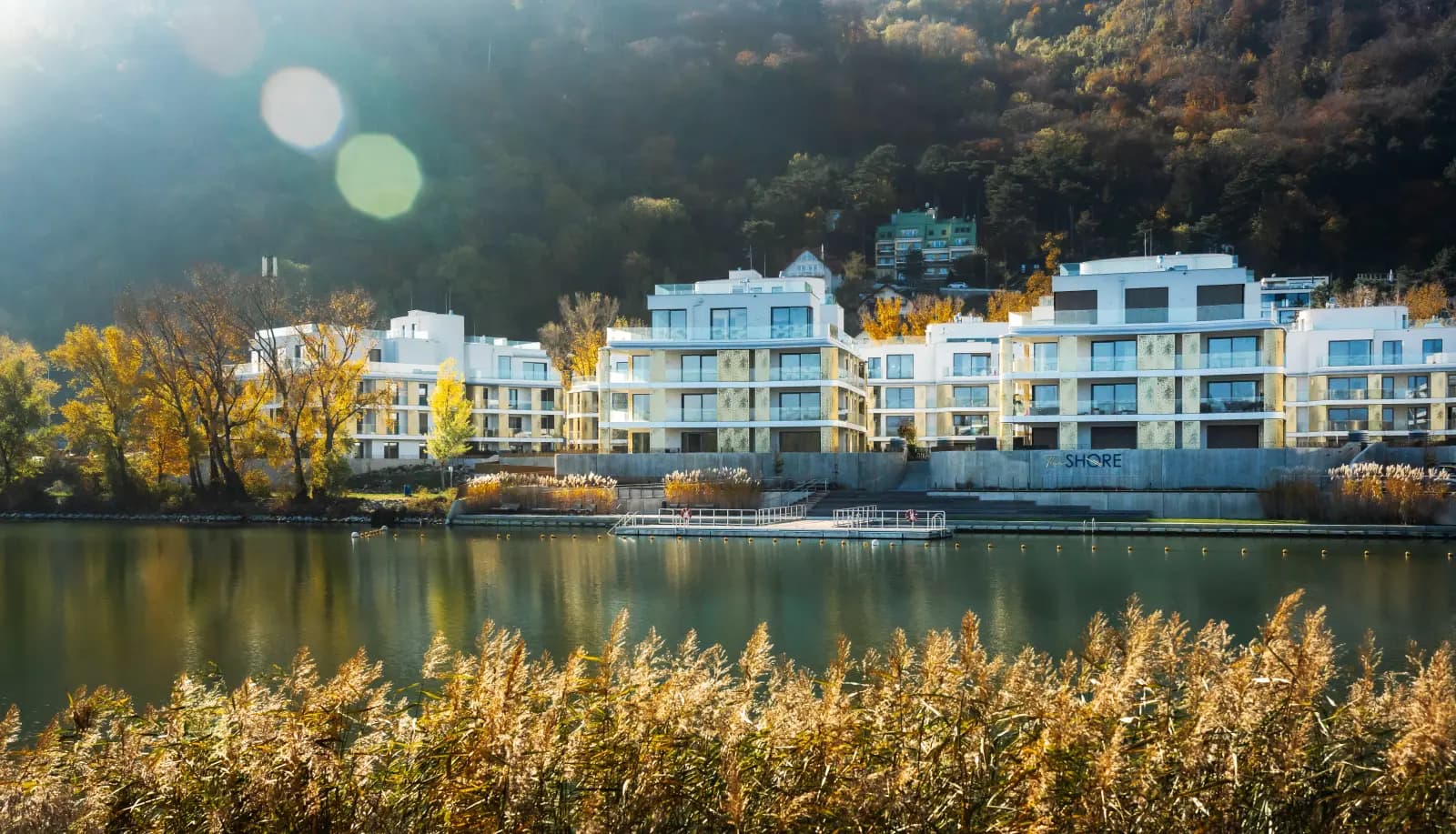
You come here once you've worked out that 110 m² in Hietzing means a million euros, while in Donaustadt it's €600,000 — with a terrace. Aspern Seestadt is almost a Swiss-style experiment in building a district from scratch: a lake, bike lanes, a school within walking distance of any flat. Young families from tech and startups land here. They want "new and just working."
Buy prices €5,500–7,500/m², family rent €1,400–1,900. The U2 puts you in the centre in 25 minutes — but after a few weeks in Seestadt, you stop needing the centre.
Downside: that "new district" feeling. The trees are still small, and winter can feel empty.
5. Penzing (14th) — Hietzing's underrated neighbour
Same green-west-of-Vienna mood, 25–30% cheaper. Steinhofgründe and the Wienerwald are out your back door, Schönbrunn is ten minutes on a bike. Buy prices €6,000–8,500/m², rent €1,400–2,000 for 80 m².
Schools are more modest (no international ones), but the public Volksschulen are solid — and plenty of expat families enrol their kids without hesitation. Give it two years and your child speaks German like a local.
Who picks it: families with a budget, who pick space over status.
6. Liesing (23rd) — a garden instead of a balcony
The southernmost district. This is where private homes with gardens start appearing — a rarity in Vienna. Maurer Wald and Lainzer Tiergarten are close, the U6 puts you in the centre in 35–40 minutes. Flats €5,800–7,800/m², houses 120–160 m² run €700,000–1.2 million.
Who picks it: families from the UK and Scandinavia, the ones for whom a garden isn't a luxury — it's normal.
7. Innere Stadt (1st) — for those who can afford it
Yes, families technically live here. Realistically: it's the 0.5% bracket. Buy prices start at €13,000/m² and easily push past €25,000 on Graben. School-wise, the French Lycée on Liechtensteinstraße is nearby; the rest is private bilingual education.
You move here when you've got the money and you want your child's walk to school to pass the Stephansdom. There aren't many downsides — but "the courtyard sandpit" gets traded for the Burggarten.
Honestly: unless you're a CEO or you inherited, skip this line.
Bottom line — which district for whom
- Big budget, prestige + schools matter most: Döbling or Hietzing
- Mid budget, academic environment: Währing
- Young family, OK with a new neighbourhood, want value: Donaustadt / Aspern
- Want green and not overpay: Penzing
- Need a garden and quiet, OK with 40 minutes to centre: Liesing
- Money isn't a question, want to live inside a postcard: Innere Stadt
All numbers in this guide are asking-price benchmarks — what owners ask, not what deals close at. Transaction prices in Vienna typically run 5–15% lower. That's a deliberate choice in our methodology: we show what a buyer actually sees on the market.
What's next
- Compare all 23 districts on data: Best Vienna Districts 2026 — by the Numbers
- District profiles: Innere Stadt · Leopoldstadt · Neubau
- Buying as a foreigner: Permits, costs, steps 2026
Disclaimer: Price and rent ranges in this article are asking-price benchmarks on the basis of publicly available data and METROX estimates as of Q1/Q2 2026. They are not appraisals, transaction databases, or financial advice. School availability, prices and admission rules change — verify directly with the school for the current term.